
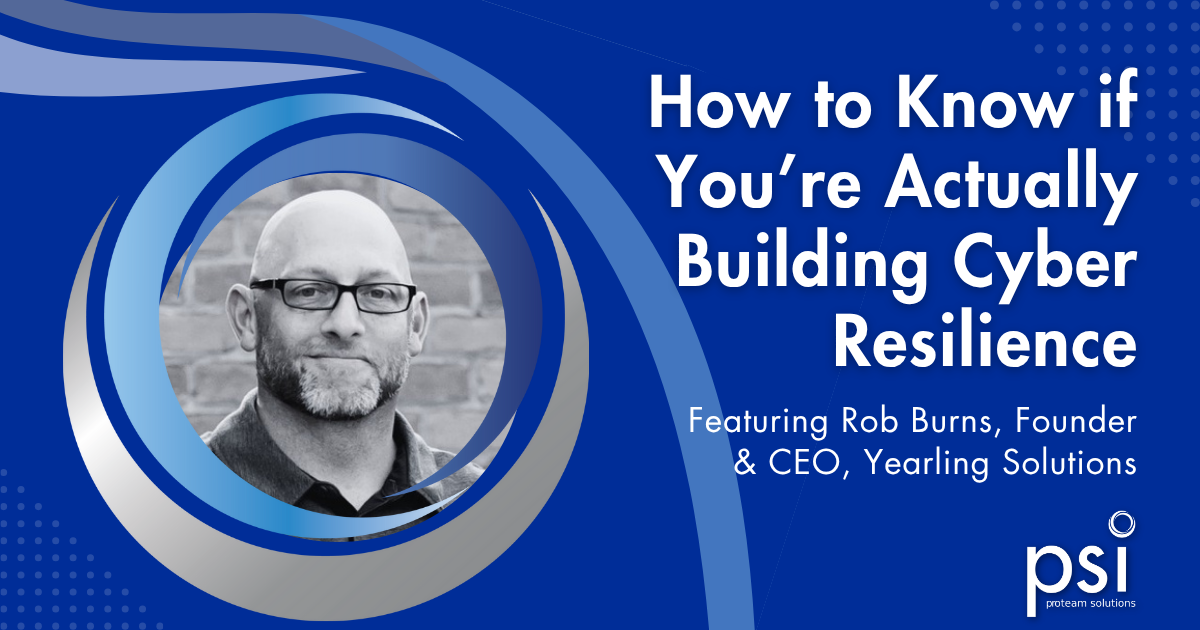
Every business leader today says they’re focused on cybersecurity resilience; but many aren’t actually building it. They’re maintaining compliance, reacting to issues, or hoping their current setup will hold.
At PSI, we’ve seen how quickly the cybersecurity conversation has shifted from IT risk to organizational readiness. Leaders are asking:
Do we have the right people?
Are our teams prepared?
Are we resilient, or just compliant?
We recently sat down with Rob Burns from Yearling Solutions, one of PSI’s trusted cybersecurity partners, to talk about what real resilience looks like and how companies can tell if they’re on the right path. Here’s a quick checklist to help you gauge where your organization stands.
1. You plan for what’s coming, not just what happened
“Most of our work centers on helping clients prepare for what’s coming, not just react to what already happened,” Rob explained.
That perspective feels especially relevant right now. Many organizations are still focused on closing gaps from the last incident rather than building systems that can adapt to what’s next. True resilience is about anticipation and having the structure, people, and decision-making agility to respond quickly when things change.
2. Your people are part of the security strategy
“The best programs are led from the top and built into the culture,” Rob shared.
It’s a reminder that cybersecurity isn’t just a technical discipline, it’s a leadership discipline. The organizations that recover fastest from disruption are the ones where every person understands their role in maintaining security and continuity.
When leaders connect technology goals with business operations and team behaviors, resilience becomes part of the company’s way of operating, not a separate checklist to manage.
3. You’re building continuity, not just controls
Rob pointed out that “cyber resilience is at the top of the list” for many organizations, especially as new standards emerge in Ohio. PSI and Yearling have been helping school systems, municipalities, and mid-sized businesses strengthen both their operational and cyber foundations for years.
Resilience means keeping essential services running and protecting public trust. If your cybersecurity planning includes continuity and recovery, not just controls, you’re building real resilience.
4. You’re integrating AI and risk, not avoiding it
“AI is changing how attacks happen, but also how we detect, respond, and predict threats,” Rob said.
That dual impact is exactly why organizations can’t ignore AI’s role in security. Yearling developed platforms like YearlingIQ and ClausePoint.AI to simplify compliance and contract workflows through AI-driven insight. PSI complements that by helping clients align people and processes so AI tools can be used safely and effectively. If your AI strategy includes risk visibility and training, not just technology adoption, you’re building smarter systems that last.
5. You’re measuring progress continuously
“You can’t just measure resilience once a year,” Rob emphasized.
Traditional audits no longer keep pace with how quickly technology and threats evolve. The most resilient organizations are those that treat resilience as an ongoing process: tracking progress, testing assumptions, and making small adjustments before small issues turn into big ones. Continuous improvement is what transforms security from a task into a mindset.
6. You treat data privacy as a core value
“Zero Data Retention — or ZDR — is going to be a key best practice,” Rob explained. “It ensures customer data isn’t stored after processing.”
It’s a simple idea with big implications. As AI becomes more integrated into business operations, protecting data isn’t just a technical task — it’s a cultural responsibility. Organizations that bake privacy and transparency into how they work earn deeper trust from clients and employees alike.
When privacy becomes part of everyday decision-making, not a compliance exercise, resilience follows naturally.
The bottom line: resilience takes partnership
Building cyber resilience isn’t about having every answer. It’s about having the right partners, the right people, and a plan that adapts.
That’s why PSI partners with innovators like Yearling Solutions. Together, we help organizations close skill gaps, strengthen execution, and build measurable resilience that lasts.
If your organization is ready to move from reactive to resilient, let’s start that conversation. Because the real question isn’t whether you’re focused on cybersecurity—it’s whether you’re building it into how your business works.
If your organization is ready to strengthen its cybersecurity posture or explore practical ways to build resilience, contact PSI. Our team can help you align people, process, and technology to move from reactive to ready.